Context
The extension based attacks are most critical as they exploit browser and OS resources. These third-party extensions (plugins) are used to enhance the core functionality of the browser, hence enjoy high privileges. With an extension based attack:
- an attacker can launch a malicious process to compromise an entire OS system
- a browser plugin have access to browser components such as cookies, password manager, browsing history, information present in a web page
- a malicious extension can run a JS script that will spawn a BASH shell on the victim’s desktop, allowing RCE (Remote Code Execution)
- browser extensions provide APIs that allows an extension to make a cross-domain requests, and this violates SOP and lead to XSS (cross site scripting)
Remote Code Execution
<script >
const lFile = Components.classes["@mozilla.org/file/local; 1"].createInstance(Components.interfaces.nsILocalFile);

const lPath = "\boot\malware.sh";

lFile.initWithPath(lPath);

const process = Components.classes["@mozilla.org/process/util; 1"].createInstance(Components.interfaces.nsIProcess);

process.init(lFile);

process.run(false, ["\boot\malware. sh"], 1);

</script>
Read password files
const file = Components.classes["@mozilla.org/file/directory service; 1"].getService(Components.interfaces.nsIProperties).get("ProfD", Components.interfaces.nsIFile);

file.initWithPath("\\\ etc \passwd");

const inputStream = Components.classes["@mozilla.org/network/file−output−stream; 1"].createInstance( Components.interfaces.nsIFileInputStream);

inputStream.init(file 1, −1, 0666, 0);

inputStream.read(result);
A browser is indeed an attractive attack surface and can be exploited
- by poor programming practices (benign but buggy extensions may be exploited)
- by malicious APIs
- by malicious JavaScript libraries
The high privileges of a browser extension may allow to bypass even the SOP (Same-Origin Policy)
- extension developers have been forced to implement their security policies
In this paper, we propose sandFOX policies, an SELinux (Security-Enhanced Linux) based sandboxing environment that isolates browser from the OS resources to ensure the protection from extension based browser attacks
- this solution allows the extensions to achieve the desired functionality in a restrictive sandboxed environment
SandFOX capabilities:
- apply restriction in accessing the file system by the browser and extensions
- protect processes running on host OS
- restrict network access by the browser and extensions
Approach
The authors have rewritten and modified SELinux configuration files to limit the behavior of Firefox and its extensions
SandFOX architecture
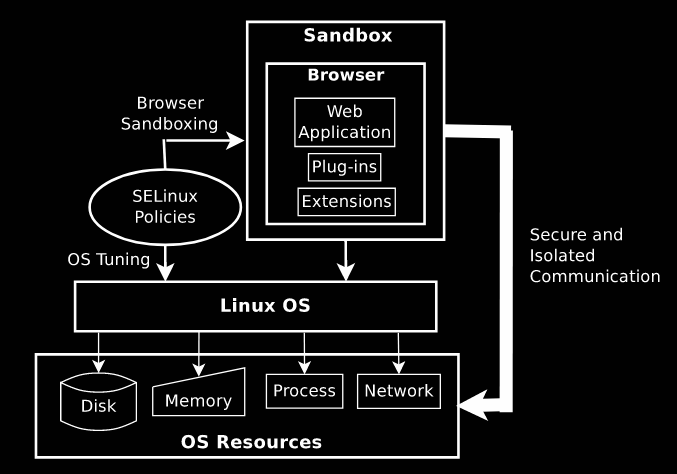
- We configure the OS using SELinux policies so that the browser can achieve its functionalities in restrictive environment
- We rewrites the SELinux policies to create a virtual cage (sandFOX) in which we can lock up Firefox browser.
- The browser running in sandFOX environment is able to achieve required functionalities but in an isolated environment
Evaluation
We evaluate our sandFOX and security policies using malicious and critical resource eating extensions. SandFOX successfully defends against:
- file system attacks (an extension is not able to read sensitive file, such as
/etc/passwd) - process attacks (an extension is not able to launch an arbitrary process)
- network attacks (an extension cannot execute cross-domain requests)
- memory attacks (reduced significantly the opportunities for buffer overflow or RCE (Remote Code Execution))
Using sandFOX leads to a minimal performance overhead (max 1 second slower)
Limits
- The author considered only Firefox browser
- The sandbox environment proposed work on Linux OS, with SELinux
- The sandFOX policy does not protect against XSS (cross site scripting), clickjacking, phishing, CSRF (cross-site request forgery)