Definition
Opposed to non-incremental (big-bang) unit testing, is an iterative process included among the white-box testing techniques. A SUT (system under test) is tested progressively, a piece at the time, and the modules are connected incrementally.
- components are tested in a step-by-step fashion
- dependencies, input/output data may be handled by a driver, or a stub
Advantages
- issues and bugs are easily detected, since the process is progressive
- it is a flexible approach, suitable for a large project
When to use this approach
When the system is complex or highly modular, the team is distributed or when a continuous feedback is required to gradually improve a system
graph TD;
    Approaches-->bottom-up;
    Approaches-->sandwitch;
    Approaches-->top-down;
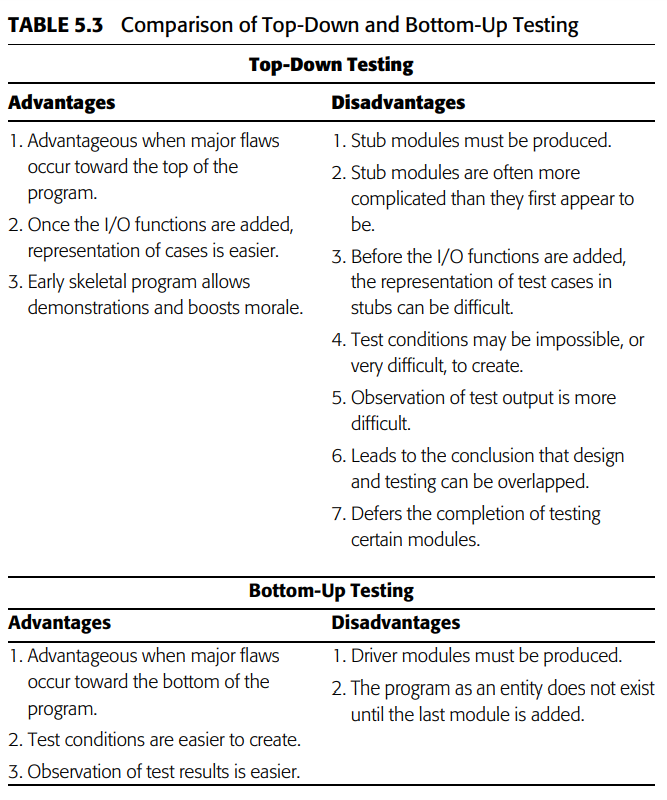
Bottom-up approach Low-level entities (e.g., single functions) are first tested and then integrated with high-level components (e.g., classes, objects). There is no specific order to select which high-level entity should be integrated first. Hence, numerous sequences are possible
Top-down approach High-level components are tested first. Low-level entities are integrated at a later time. Again, there is no specific order to respect.
Sandwich approach A mixed approach is taken, combining bottom-up and top-down techniques.
Warning
More time-consuming than an non-incremental approach. It depends on drivers and stubs